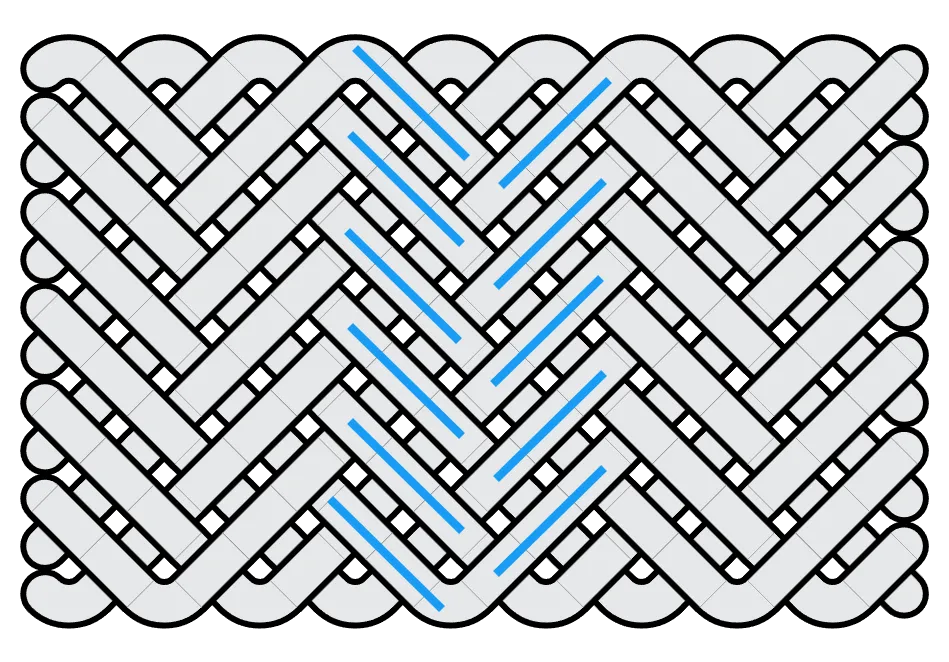

Crossings & Facets
Knots are commonly described as having some number of crossings and facets. The crossings to facets ratio:
- Determines a knot’s tactile feel (knurling).
- Significantly impacts strand length.
- Suggests how fast the knot can be tied and how easy it will be to dress.
Imagine you need a handle covering that is 6” long with a 1” diameter. A Turks Head has great knurling, but because every crossing is also a facet (1:1 ratio), it will need more material, take longer to tie, and be harder to dress.
If we switch to an O2U2 pattern, the ratio becomes 2 crossings to 1 facet. This knot has bigger knurling, uses less material, is faster to tie, and easier to dress.
Crossings
Section titled “Crossings”Crossings is the number of X’s formed by strands crossing each other in opposite directions.
Crossings is calculated as: (Bights * Parts) - (Bights * Bight Nests) * Bight Nests
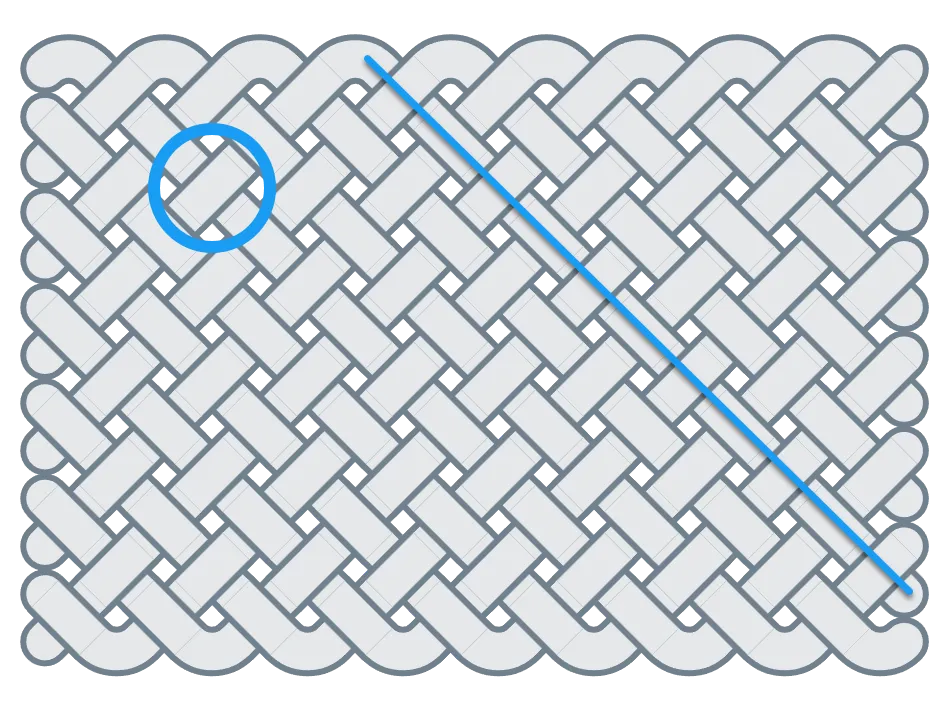
The easiest way to count a knot’s crossings is by following strands on the diagonal. Here the diagonal line shows 11 crossings. This Turks Head has 108 crossings.
Facets
Section titled “Facets”Facets are the unbroken runs of overs in a knot.
Facets can be estimated as: Crossings / Repeating Overs.
A Turks Head knot uses an OU coding pattern. The result is that every crossing is also a facet. This knot has 108 crossings and 108 facets.
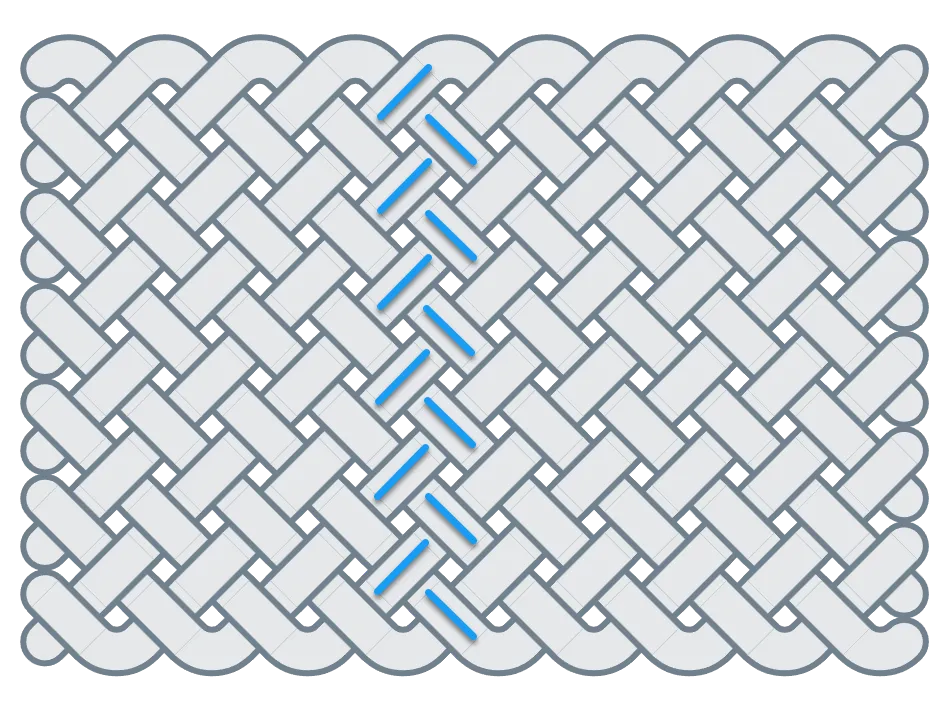
This Fan knot uses an O3U3 coding pattern. This knot has 99 crossings and 33 facets.